Limitations of Process Mining
Process mining has helped organizations gain valuable visibility into the application-oriented aspect of business processes. It gives us a very concrete view, but it’s a partial view. Process mining focuses on what applications are doing, but by its nature is largely unaware of manual activities, policies and business rules (human and system-oriented), and it may not be aware of processes that span applications. Because of its partial context, its understanding of change impacts across the organization is limited, as is its ability to assess how much business value changes may realize.
Supplements Please!
What’s needed to supplement the output of process mining is:
Translation of mining data into BPMN Business Process diagrams so they are readily suggested by us humans
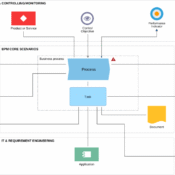
A framework context for the process that shows clearly how they fit in the Enterprise Business Architecture. This enables rapid and consistent context for all who view the models, which boosts productivity, enables better communication and reduces errors.
An operational view of the process that reconciles the Process Mining prior with the framework and on the grounds business practices.
Having all three views is necessary if you want a broader, more detailed and reliable view of your business.
Synthesizing Metrics
Metrics are of course essential in evaluating business performance. My three pronged approach provides metrics from:
A management point of view (goals, KPIs, SLAs, delivery timeframes)
A process practitioner’s point of view (manual, semi-automated and automated tasks)
An application point of view (hard metrics from system logs, status codes and system-oriented process performance)
Framework Essential
Having a good framework is essential for managing your business, and more businesses are realizing this every year, with model led business analysis becoming standard practice in leading organizations. Being able to plug data into a framework is one thing; being able to query and navigate your organization, processes and applications is another. If your data is locked in Visio for diagrams and Word for metrics and narrative, you have a real challenge! If you put it all in Excel, you also have a challenge as it lacks visualisation capability which is something the majority of us humans relate to in digesting concepts and navigating complex data.
Reconciliation?
It is not possible to reconcile all three views without the help of a Business Architecture professional and a proper Enterprise Business Architecture platform because:
A modeling platform helps organize and express framework concepts so users can navigate them
It facilitates the expression of workflows / business processes in BPMN and associated diagrams
It houses the metrics against the artefacts in the repository, making them really available through dialogue attached to objects such as activities and roles in the model.
You Need Expertise
Do not be fooled by software vendors who push Process Mining as the turn-key solution to process performance management! Likewise, do not grab onto a modeling platform and start using it without having adopted and trained staff in a business framework. Lastly, do not give staff who are involved in an area the responsibility of modeling it for they are biased and limited in their ability to interview staff, analyse results and plug it all into the framework incorporated into the modeling environment.
You need a Business Architect professional with proven Process Analysis techniques, ability to interview from CEOs to Janitors, a good comprehension of Frameworks and Architectures and a gift at socializing the results to motivate positive change.
If you want a positive journey for your business improvement efforts and would like to look back in a year’s time with satisfaction, you should call The Process Expert on 0483 891 835 or visit theprocess.expert.