Yet Another Blind Men Analogy?
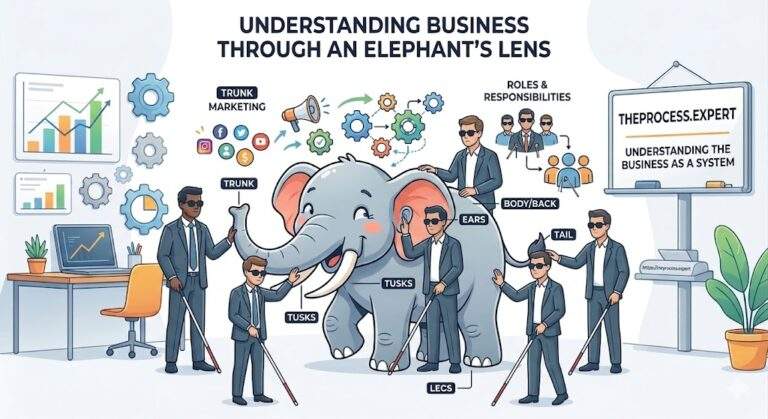
Have you heard about the blind men who were each asked to explain what an elephant felt like? They all came back with something different because they matched into a different part of the animal and considered that experience to be the whole. Something similar is happening with BPMN usage. Pundits have hold of a leg, an ear, the trunk or even the tail and are relating their experience as if they know the whole, not just a part.
People can see a business from different perspectives and getting them on the same page can be a major effort! Surely there’s something that could help us describe our business operations in a way we all understand!
BPMN - Much More Than A Drawing!
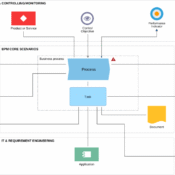
BPMN is a powerful notation and it’s capable of covering C-level processes, operational processes and IT integration processes. It’s capable of including Roles, Departments, Locations and Applications. There’s also a BPMN Conversation Diagram that shows how roles, departments or applications interact with processes.
A BPMN pundit who’s promoting himself on LinkedIn recently posted in LinkedIn asserted that BPMN diagrams are all just stories and every diagram should be readable to all staff. That’s a very narrow interpretation of the BPMN 1.0 Process diagram, not BPMN 2.0 with its four kinds of diagrams!
The way I use BPMN process diagrams really depends on the level and purpose of the BPMN diagram, which is very contrary to the somewhat limited view the ‘pundit’ has.
Four Kinds of BPMN Diagram
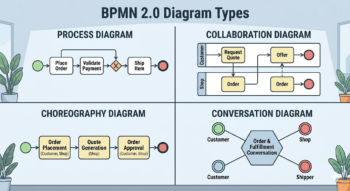
In all, there are actually four diagram types in BPMN:
1. Process Diagrams: these define internal workflows that occur within business proc-
esses (called orchestration in BPMN).
2. Collaboration Diagrams: these define communication (message flows) among participants: how business processes interact with their environment.
3. Choreography Diagrams: these define communication protocols among participants
and consist of sequences of message exchanges.
4. Conversation Diagram: this is a simplified version of a Collaboration Diagram, with
individual messages grouped into conversations.
The last two are new diagram types introduced in BPMN 2.0.

Who Are You And What Do You Want?
At the level that sits with the exec and Process Architecture, the models need to be very legible to execs, so he’s spot on there, but there’s more!
Operational models can be two or three levels down from there and really need to leverage a more complete set of BPMN symbols to achieve the kind of detail that’s in the operational layer.
Then there’s the level of detail that deals with application interactions and integrations. At that stage, we are dealing with web services, web hooks and APIs. CEOs do not know about these and 99% do not want to know!
Pick Your Flavour (Tool)
BPMN is a very powerful and multi-faceted notation that functions at a number of levels.
Don’t forget also that it can be used to represent a state machine using events and the transformations in between become the process level down.
I find the BPMN Conversation diagram which is handy for the kind of approach I used for many years with the Six Sigma Business Interaction Model, so handy at C-level. Give this a go if you need to map out interactions and what they are producing before diving into process detail.


Good For PNG!
I’ve recently enjoyed working again with Zertain, this time for Kina Bank, who are in Papua New Guinea. The Project Manager from Kina is an Australian fellow who understands they’re operations fairly well. When it came to nutting out a high level process, we used state transitions on BPMN as I have described above, which then are used in a meta-process that acts as a template for more specific sub-types. This approach lets me set a basic pattern, expand on it and then look at more specialized forms for different products, locations, customer types, complaint types etc.
Take A Look At This Explanation...
I have on my website a page I did a few years ago that steps through what I regard as the best diagrams for levels of detail. You may find it very informative. See https://theprocess.expert/modelling-your-business-for-executives and reach out to me for an obligation free discussion on where you are at and what you are trying to achieve.
Please be aware that AI is currently revolutionising interviews, process analysis and BPMN diagram creation. Reach out to me for help. Don’t get left behind!

Interested in ADONIS?
Interested in the ADONIS platform for Australia or New Zealand? I offer guided tours, community editions, POCs, and pilot projects tailored to your needs. Reach out — let’s make AI work productively for your business.