How can you maximise your chances of success with an AI business improvement project?
Any AI can only work with the data it is given and many of them struggle with context and memory, which means you only get a portion of what you hoped for! Many AI projects are running into trouble because they don’t do business analysis completely or well enough. When a business does try to approach an AI project from a business improvement perspective, they have a better chance of success, but organising the AI properly is also a significant success factor!
‘PLAYING WITH AI’
Confession time: I have played with AI to test its abilities. I have developed some apps using AI based apps development platforms like Rork, RapidNative and Bilt, which all leverage the benefits of the Expo framework. What really came home to me as I did this is that it’s just like the early days of Agile.
MEMORIES OF AGILE
I well remember our first Agile project at a large company I worked for. The very privileged team members were so excited about being able to code quickly and responsively. It was a great success in that regard. What they missed was leveraging corporate services our group had established. Services like address validation! Why reinvent the wheel when there’s an architecturally sound service available? The team really didn’t see my point when I said it was quicker and better to drag a service off the rack and wire it up than to write their own code!
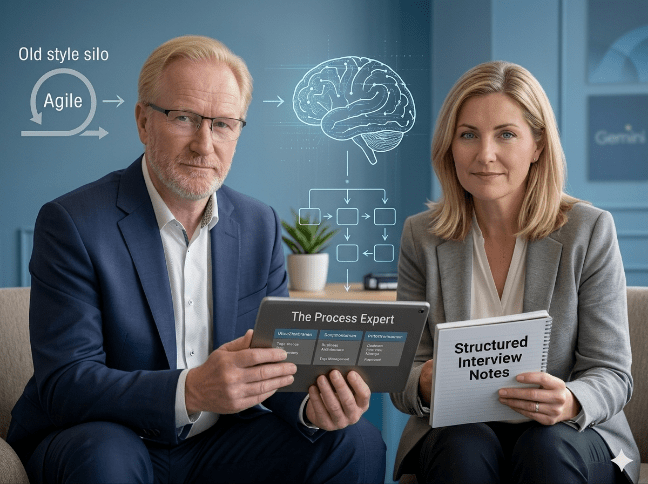

FAST FORWARD
NO-CODE made similar promises to Agile as far as speed of development and ability to see what business people wanted actually being implemented. NO-CODE exponents did the same as Agile ones – they rushed the gates, determined to build as quickly as possible. Why is it that when a new technology appears that doing a ‘quick and dirty’ seems to be the most prevalent response? I went to Creatio’s NO-CODE DAY 2024 as a new Creatio NO-CODE CRM Consulting Partner. I took with me the following pamphlet:
I hope you get the point.
EXTRAPOLATE TO AI
I hope I have painted a picture of common business responses to new technologies. Agile, LOW-CODE, NO-CODE and AI all presented revolutionary opportunities to develop and scale, but most businesses failed to realise the benefit because they failed to see how to best use the advances!
WHAT’S THE POINT?
AI is amazing, and companies are seeing benefits. Many will create a mess though! They win with one hand and lose with the other!
WHAT IS REQUIRED TO SUCCEED?
I recommend the following be taken into consideration when you attempt to use AI agentically to improve your business:
- A Business Improvement Approach
Structured interviews led by experienced Business Analysts - Human centric methods prevailing over AI centric methods, using sound business process, information and organisational modelling
- AI drawing conclusions, generating extra questions and suggesting solutions, but experienced business analysis, project managers and solution designers remaining in control
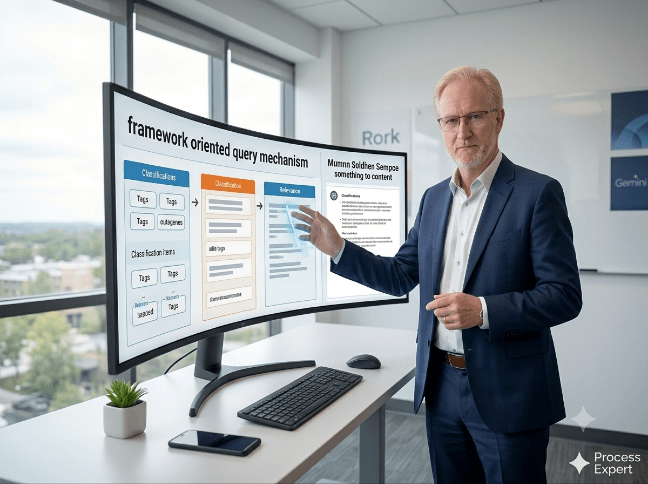
APPROACH TO AI
A human centred approach to technology change and change management, which considers who is involved and how they are impacted; when and how change should take place and what training is required. In my experience, it is frequently a deficit in the human factors that erode value in what are otherwise well intentioned and innovative projects
A meta-model or ‘framework’ for the AI to work with that helps it classify different types of information and determine its relationships and relevance. This has been one of the major challenges I have personally seen as very clever people have set out to exploit AI’s capabilities.
A framework oriented query mechanism that helps business people pose questions and interpret answers so context is preserved and AI doesn’t hallucinate on your business!
COMPANIES ARE MAKING THE EFFORT!
There are a number of companies that are trying to build methodology on top of AI to help with projects.
Some are letting AI lead and are sanity checking it along the way.
Others are putting guard rails in place and steering AI along the way
A few are designing the way they use AI and trying to structure the interactions and replies to work with project methodologies
A rare handful are looking carefully at the semantics AI works with and helping it to better classify information in such a way that it has deeper significance and increased potential to answer questions and generate positive technology change that is well received by their organisation and customers.
My interest as a Business Architect is to:
Assist you to shape AI projects that will genuinely benefit your business
To help you define an Operational Model of your business that AI can easily ingest and use
To leverage the power of AI in such a way that results in positive, controlled and all received change on the ground.
AI Project Success
= Business Architecture
+ AI Governance Framework
+ Human Centric Change Management
KEY STRATEGIES FOR SUCCESS
- Adopt a Business Improvement Approach: Ensure the project starts with sound business analysis and modeling rather than rushing straight to technical implementation.
- Maintain Human Control: Use experienced Business Analysts, Project Managers, and Solution Designers to direct the project. While AI can draw conclusions, generate extra questions, and suggest solutions, humans should remain in control and validate the AI’s output.
- Implement a Structured Meta-Model: Provide the AI with a structured framework or “meta-model” to help it classify different types of information, preserve context, and understand relationships between data.
- Use Framework-Oriented Queries: Establish query mechanisms that guide how business people ask questions and interpret responses, preventing the AI from hallucinating on your business data.
Prioritize Human-Centric Change Management: Address how employees are impacted by considering training needs, transition timing, and the human factors that often erode project value. - Build an Operational Business Model: Create a clear, architecturally sound model of your business processes, information, and organizational roles for the AI to ingest so it can accurately identify blockers and opportunities.
YOU NEED AN EXPERT
I am an expert process analyst and data modeller. I also look at organisational structure and roles as I engage with a client. Because my approach is grounded in business architecture, I often find I have insights which are previously unrealised, unclouded by technology considerations. My aim is to provide a sound Business Operations Model that helps you understand your own business, where the problems and blockers are, and where the opportunities are. It is much easier to use AI in that context and easier to realise benefit.
AI is only as smart as the information you give it. The LLMs that drive so much of AI are becoming more mature and capable, but letting them out to play in hope business without someone directing and governing them is like giving children razor blades to play with. The chances of blood on the ground are very high!
If your organisation is considering an AI project, or may be that a free consultation with The Process Expert would both be good insurance and helpful in setting some direction. Please call or text me on 0483 891 835 to arrange a free, no-obligation consultation. I work with companies around the world, and regularly talk to people in the USA, India, Europe, Philippines etc, so don’t hesitate to reach out.
QUESTIONS AND ANSWERS

Q. Why do many AI projects fail to deliver their expected value?
A. Many AI projects fail because organizations rush to build without doing thorough business analysis, and because AI models often struggle with context, memory, and classifying information properly.
Q. What is the recommended approach to implementing AI for business improvement?
A. Success requires a human-centric, business-first approach using structured interviews, clear business process modeling, and strong governance from experienced analysts and project managers rather than letting AI run undirected.
Q. How does a business meta-model help prevent AI hallucination?
A. A meta-model or framework helps the AI properly classify different types of information, understand relationships, and maintain context, which prevents it from generating false or inaccurate insights about your business.
Q. Why is human-centred change management important in AI projects?
A. Deficits in addressing human factors—such as how employees are impacted, when change takes place, and proper training—frequently erode the actual value of otherwise innovative AI implementations.
Q. How can a Business Operations Model assist an AI implementation?
A. A sound Business Operations Model clarifies business processes, information flow, and organizational roles, making it easier for the AI to ingest accurate data and identify real operational blockers and opportunities.